
Introduction
Material selection decides whether an injection-molded part survives its service life or fails in the field. The right resin grade delivers strength, dimensional accuracy, and the right look. The wrong one warps, cracks, degrades chemically, or shrinks out of tolerance.
Picking a resin by reputation alone is risky. A material that works well in one application can crack, discolor, or fail prematurely in another with different loads, temperatures, or chemical exposure.
This guide walks through a practical selection process:
- Define the part's actual requirements first
- Understand material categories and how they behave
- Compare properties against real operating conditions
- Account for moldability and regulatory compliance
- Validate your final choice with a qualified molding partner
Get this process right, and you avoid costly tooling rework, field failures, and production delays.
Key Takeaways
- Match materials to mechanical, thermal, chemical, electrical, and regulatory requirements — not resin popularity.
- Amorphous and semi-crystalline thermoplastics process and perform differently; know which category you're working with.
- Grade, fillers, moisture sensitivity, and processing conditions matter as much as the base polymer.
- Compare total cost per part, not just resin price per pound.
- Prototype early and loop in your molder before tooling is finalized.
What Are Injection Molding Materials?
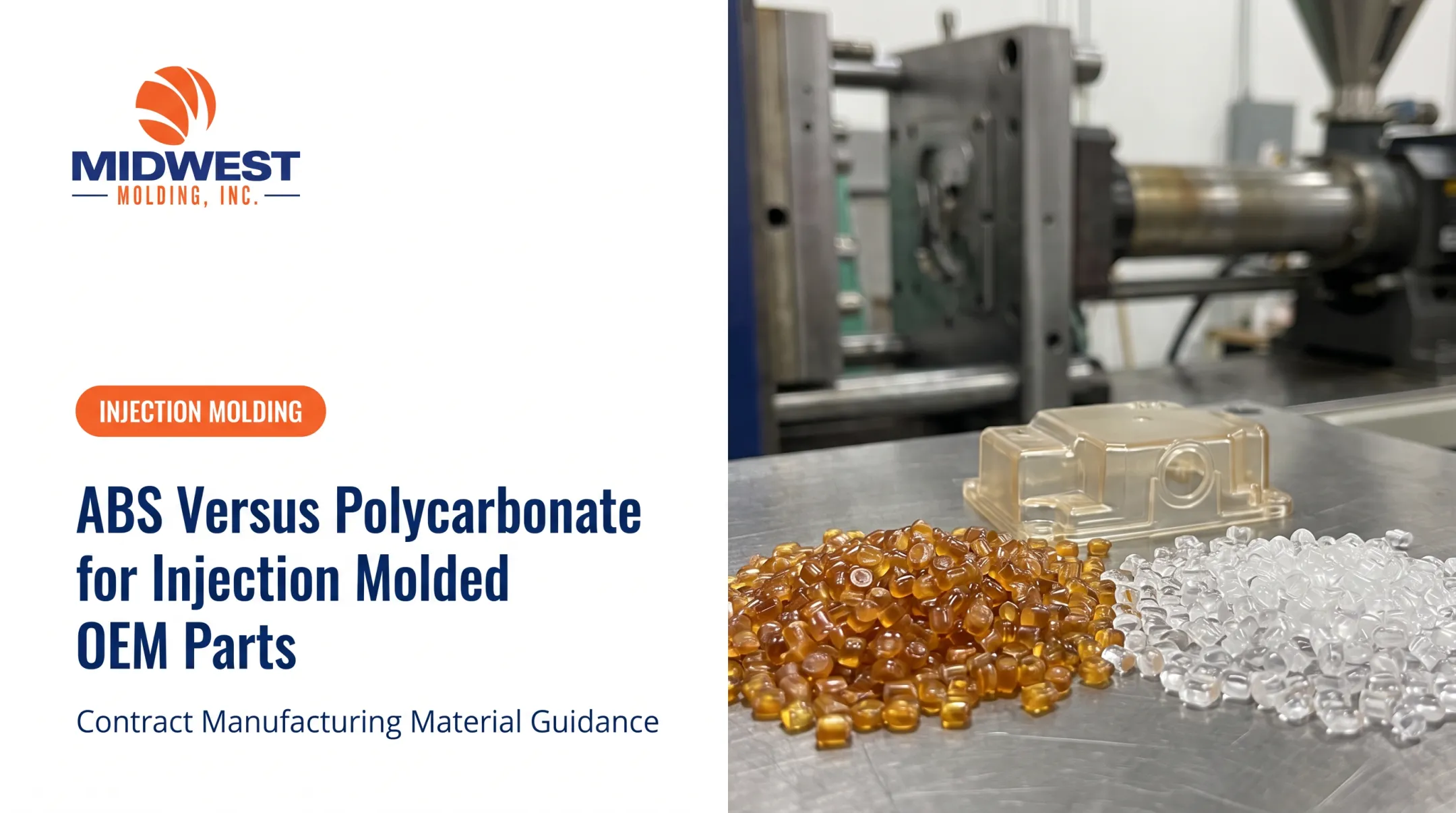
Injection molding materials are polymer-based compounds, typically supplied as pellets or granules, that get melted, injected into a mold cavity, cooled (or cured), and ejected as a finished part.
Choosing a material means more than picking a polymer family name. The real decision involves a specific grade, plus any colorant package, glass or mineral reinforcement, flame retardant, UV stabilizer, impact modifier, or recycled-content formulation layered on top of it. Two parts molded from "the same plastic" can behave completely differently once you factor in these additions.
Thermoplastics and Thermosets
Thermoplastics soften when heated and solidify when cooled. This reversibility makes them the dominant choice for injection molding. They allow repeatable processing and, in many cases, reprocessing or recycling where the formulation and application permit it.
Thermosets undergo an irreversible curing reaction during molding. Once cured, they can't be remelted. Manufacturers select them for specific heat, electrical, or chemical stability needs, but they require different equipment, tooling, and process controls than standard thermoplastic molding.
Amorphous and Semi-Crystalline Thermoplastics
Amorphous materials (ABS, polycarbonate, and PMMA) generally offer good surface finish, dimensional consistency, and sometimes transparency. They soften gradually across a glass-transition range rather than melting sharply, and they can be sensitive to specific solvents and stress-cracking agents.
Semi-crystalline materials such as polypropylene, polyethylene, nylon, POM, PBT, and PPS often deliver stronger chemical resistance, wear performance, fatigue life, or thermal performance. The tradeoff: they demand closer attention to shrinkage, crystallization behavior, cooling rates, and warpage.
The shrinkage gap between these two categories is real and well-documented. Covestro's resin shrinkage guide reports unfilled amorphous resins typically shrink less than 1%, while semi-crystalline resins commonly shrink more than 1%. Tool designers need this distinction before cutting steel, not after.

Common Material Families and Typical Applications
Commodity materials suit cost-sensitive, high-volume parts:
- PP: snap-fit housings, caps, containers
- PE/HDPE: crates, pails, chemical containers
- PS: disposables, stationery, clear molded items
- PVC: pipe fittings, electrical insulation
- ABS: appliance housings, consumer product shells
Engineering materials step up when parts need higher performance:
- PC: impact resistance plus optical clarity for lenses and electrical housings
- Nylon (PA6/PA66): strength and wear resistance for automotive manifolds and wear surfaces
- POM/acetal: low friction for sliding parts and moving assemblies
- PBT/PPS: electrical insulation and chemical resistance for connectors
Application-specific materials fill specialized roles: TPE and TPU for elastomeric seals and flexible components, PMMA and PC for clarity, and high-performance options like PEEK or LCP for thin-wall, high-temperature electrical parts. These aren't default choices. Verify processing requirements and current grade data with the resin supplier before committing.
What to Consider When Choosing the Best Injection Molding Material
These factors connect raw material properties to outcomes you can actually measure: part life, dimensional accuracy, cycle time, scrap rate, and total cost. Before comparing datasheets, build a simple checklist covering load conditions, temperature range, chemical exposure, appearance requirements, expected service life, production volume, and applicable standards.
Mechanical and Functional Performance
Tensile strength, flexural modulus, impact strength, fatigue resistance, hardness, and elongation all connect directly to how a part gets loaded and moved in service. A snap-fit clip needs different properties than a structural bracket or a load-bearing housing.
Short-term datasheet numbers don't tell the whole story. A single tensile test captures performance at one moment, under one set of conditions. Real parts face repeated loads, sustained stress, elevated temperatures, and impact over months or years. For safety-critical or heavily loaded components, lean on supplier design guidance and engineering analysis rather than a single datasheet column.
Moisture conditioning alone can swing numbers dramatically. BASF's datasheet for its glass-filled Ultramid B3WG6 (a reinforced PA6 grade) shows tensile stress at break dropping from 185 MPa dry to 115 MPa after moisture conditioning, with tensile modulus falling from 9,500 MPa to 6,200 MPa. That gap is large enough to separate a part that works from one that fails, depending on which number you designed against.
Fillers and reinforcements (glass fiber, mineral fillers, impact modifiers) can improve stiffness, strength, or dimensional stability. But they come with tradeoffs:
- Reduced flow, requiring adjusted gate and runner design
- Surface appearance changes (fiber bloom, texture)
- Anisotropic shrinkage — different shrink rates along and across flow direction
- Increased tool wear from abrasive fillers
Thermal and Environmental Resistance
Operating temperature range matters, but so does duration. A material might handle a brief excursion to 150°C without issue while failing under continuous exposure at 100°C. Account for heat deflection temperature, glass-transition or melting behavior, thermal aging, and coefficient of thermal expansion together, not in isolation.
A critical warning: Heat deflection temperature (HDT) is a short-term test value, not a long-term allowable-use temperature. The test measures how much a specimen deflects under a specific flexural load as temperature rises. It says nothing about how that material performs after months of continuous heat exposure.
ASTM D648 defines this specific test method, and treating its result as a service-life temperature is one of the more common mistakes in material selection. Always verify against the resin supplier's long-term thermal aging data and the part's actual loading conditions.
Also evaluate exposure to:
- Moisture and humidity cycling
- UV radiation and outdoor weathering
- Fuels, oils, and cleaning agents
- Solvents, acids, and bases
- Environmental stress-cracking conditions
A polymer family's general chemical-resistance reputation doesn't replace grade-specific testing. Colorants, additives, and processing can shift how a specific batch responds to the same chemical.
Electrical, Regulatory, and Application-Specific Requirements
Electrical and electronic components often need dielectric strength, volume resistivity, arc resistance, or flame performance ratings. Before selecting a grade, identify which standards actually apply:
- UL ratings for flammability and thermal aging
- RoHS restrictions for products entering markets with hazardous-substance rules
- REACH substance declarations for supply chain compliance
- Customer-specific electrical or safety specifications
Food-contact, medical, automotive, and child-product applications need material-specific documentation and traceability, not generic claims about an entire polymer family. A resin's family name alone doesn't establish regulatory compliance; the specific grade, colorant, and additive package all factor into the determination.
Always verify current compliance declarations for the exact formulation you plan to mold, not a close relative of it.
Moldability, Part Geometry, and Processing Requirements
Melt flow rate, viscosity, gate location, wall thickness, and venting all affect how well a mold fills and how the finished part looks. A higher-flow grade is not automatically the strongest or most durable choice. Flow and mechanical performance are separate properties, and suppliers sometimes trade one for the other.
Common processing defects connect directly back to material behavior:
| Defect | Common Cause |
|---|---|
| Warpage | Uneven cooling, differential shrinkage |
| Sink marks | Thick sections, insufficient packing |
| Flash | Excessive injection pressure, worn tooling |
| Splay | Moisture, excessive shear or heat |
| Short shots | Insufficient flow, undersized gates |
Moisture-sensitive materials deserve special attention. Nylon, PC, PET, PBT, and some ABS grades absorb atmospheric moisture readily. Molding them wet can cause hydrolysis, splay, and weakened mechanical properties. Follow the supplier's specific drying time and temperature recommendations. These vary by grade and shouldn't be guessed at or copied from a different resin's datasheet.
Production Economics and Supply Considerations
Resin price per pound tells you almost nothing about true part cost. Total cost of ownership includes:
- Material usage and scrap rate
- Cycle time and drying energy
- Mold temperature requirements
- Regrind policy and tooling wear
- Secondary operations and assembly labor
A premium engineering resin may actually cost less per accepted part than a cheaper commodity grade if it reduces scrap or eliminates a secondary operation. For low-volume prototypes, paying more for a forgiving, well-characterized material often makes sense. For high-volume production with modest requirements, a commodity resin may be the smarter call.
Before finalizing tooling, also check resin availability, approved alternates, grade consistency, and lead times. Switching materials after a mold has been cut for a specific shrinkage rate is expensive and sometimes impossible without rework.
Validation and Final Selection Process
A practical sequence for narrowing down candidates:
- Define requirements — document mechanical, thermal, chemical, and regulatory needs
- Screen material families — eliminate categories that clearly don't fit
- Shortlist two or more grades — compare supplier datasheets side by side
- Review moldability with your toolmaker or molder
- Assess total cost across the full production lifecycle

Validate finalists with prototype parts, sample plaques, or pilot molding runs. Test fit, function, dimensional stability, and exposure to representative temperatures or chemicals before committing to production tooling.
Document the approved grade, supplier, colorant package, processing window, and inspection requirements. This record keeps future production runs consistent, especially if the project changes hands or scales up.
How Midwest Molding, Inc. Can Help
Material selection doesn't happen in a vacuum — it connects directly to part design, tooling, molding method, and production volume. Midwest Molding, Inc., a Bartlett, Illinois-based injection molding and assembly manufacturer, offers guidance on molding processes and parameters so customers can weigh these connected decisions rather than evaluating resin choice in isolation.
Early collaboration matters most for complex builds:
- Insert molding and composite molding
- Overmolding and two-shot molding
- Gas assist molding
- Parts moving into downstream assembly or welding
Midwest Molding's engineering support includes Mold Flow Analysis and ES Testing during prototype and production tool build management, plus part re-formulation support when a material or design change could reduce cost without compromising function.
The company operates 55 all-electric injection molding presses (50 horizontal, 5 vertical) across a broad range of press sizes, backed by three 45,000-lb material silos and handling systems that support consistent, high-volume production.

Midwest Molding holds IATF 16949 certification for automotive-quality injection molded and insert molded production, along with ISO 14001:2015 certification for environmental management. Its management team brings an average of more than 35 years of manufacturing experience.
If you're evaluating material and process options for a new or existing part, come prepared with:
- Part drawing or 3D model
- Service environment and load/temperature requirements
- Annual volume and compliance needs
- Appearance expectations and insert details
- Target cost
Manufacturers of automotive, transportation, electronics, appliance, and consumer goods components can connect with Midwest Molding's team to discuss material requirements alongside tooling and production needs.
Conclusion
The best injection molding material is the one that actually satisfies your part's functional, environmental, regulatory, processing, and cost requirements, nothing more abstract than that. Broad labels like "strong," "heat resistant," or "chemical resistant" don't substitute for comparing specific grades and formulations against your real operating conditions.
Material selection isn't a one-time decision, either. As design, volume, regulations, and resin availability shift, revisit your choice. Loop in your molding partner before the resin and tool design are locked in. That conversation is far cheaper before tooling than after.
Frequently Asked Questions
What kind of plastic do they use for injection molding?
Injection molding commonly uses thermoplastics such as ABS, PP, PE, PC, nylon, POM, PBT, PS, PMMA, TPE, and TPU. The right choice depends on the part's performance, environment, processing, compliance, and cost requirements, not one universal "best" plastic.
Is HDPE good for injection molding?
HDPE offers solid chemical resistance, impact performance, moisture resistance, and relatively straightforward processing. As a semi-crystalline material, though, it needs attention to shrinkage, dimensional control, temperature limits, and UV stability in outdoor applications.
Can Delrin be injection molded?
Yes. Delrin (DuPont's acetal/POM) is commonly injection molded for moving assemblies and wear surfaces because of its low friction, stiffness, and wear resistance. Follow each grade's drying, processing, and shrinkage guidance from the supplier.