
Picking the wrong process doesn't just affect your mold quote. It can lock you into excess material use, longer cycles, or parts that need rework before they ever reach assembly. That ripples through tooling investment, material consumption, part quality, production efficiency, and downstream costs.
US manufacturers keep investing in both. Import data shows 4,976 injection-molding machines entered the US through September 2025, alongside 1,228 blow-molding machines — a signal of strong equipment demand across both processes, not a verdict on which one wins more often.
This article breaks down the real cost and design differences: geometry, wall thickness, tolerances, material, volume, and tooling, so you can match the process to the part.
Key Takeaways
- Blow molding fits hollow, thin-walled products; injection molding fits solid or detail-heavy components.
- Lower-pressure tooling can give blow molding a cost edge; injection molding wins on precision, inserts, or multi-material work.
- Real per-part cost includes material, cycle time, scrap, and tooling amortization, not just the mold quote.
- Match the process, and the partner, to the part's requirements and production plan.
Blow Molding vs. Injection Molding: Quick Comparison
Cost
Blow molding uses lower operating pressures, which generally means lighter, less expensive tooling for suitable hollow products. That's not a universal rule: part size, cavitation, and automation still swing the number.
Injection molding needs higher-pressure equipment, cooling channels, and sometimes slides or lifters to hold tight tolerances. That raises the initial investment, but high production volume spreads tooling cost across more parts and can bring per-unit price down sharply.
Product Geometry
- Blow molding: Hollow, thin-walled containers and components formed by expanding a parison or preform with compressed air.
- Injection molding: Solid or structurally complex parts formed by filling a mold cavity with molten resin.
Precision and Wall-Thickness Control
Blow molding's wall thickness depends heavily on parison control, die-gap behavior, and temperature consistency. Off-center parisons can thin one wall more than the other, so dimensional guides tend to be broad rather than tight.
Injection molding separates tool-machining tolerance from resin shrinkage allowance. Different materials shrink at different rates, so the finished-part tolerance is a combined figure, not a single number.
Actual performance in both processes depends on material, mold design, machine settings, and validation testing.
Production and Post-Processing
- Extrusion blow molding closes around a parison, inflates it, cools it, then trims flash, an extra step that adds time and labor.
- Injection molding can run multiple cavities in parallel, producing several finished parts per cycle with minimal trimming beyond gate removal.
Best-Fit Applications
| Process | Common Applications |
|---|---|
| Blow molding | Bottles, tanks, ducts, fluid containers |
| Injection molding | Housings, connectors, automotive components, sensor bodies, overmolded parts |
What Is Blow Molding?
Blow molding heats a plastic tube or preform, encloses it in a mold, and expands it against the mold walls with compressed air. The result: a hollow part with a controlled outer shape and a less controlled inner wall.
The typical extrusion sequence:
- Form the parison (the hot plastic tube)
- Close the mold around it
- Introduce compressed air to inflate the parison against the cavity walls
- Cool the part until it holds its shape
- Open the mold and eject
- Trim flash or excess material
There are three main variations, and each fits different bottle or container requirements:
| Variation | How It Works | Typical Use |
|---|---|---|
| Extrusion blow molding (EBM) | Extrude a hot parison, close, inflate, cool, trim | Larger HDPE/LDPE/PP bottles, larger necks |
| Injection blow molding (IBM) | Injection-mold a preform, then blow to shape | Bottles needing tighter, controlled necks |
| Injection stretch blow molding (ISBM) | Mold and condition a preform, stretch it, then blow | PET beverage containers, improved barrier properties |
Lower-pressure tooling and thin walls can reduce material and tooling expense. But parison control, flash removal, wall-thickness variation, and specialized cooling equipment all add cost back in. The savings aren't automatic.
Design constraints to plan around:
- Hollow geometry with draft and neck design built in from the start
- Pinch-off areas where the mold seals the parison
- Wall-thickness distribution that varies by part location
- Handles, openings, and features that complicate tooling
- Leak or pressure testing requirements for fluid-carrying parts
Use Cases of Blow Molding
Blow molding earns its place once a container or component design is validated and tooling is ready for high-volume runs. Representative US applications include:
- Consumer beverage and chemical bottles
- Automotive fluid tanks and reservoirs
- Industrial ducts and ventilation components
- Large-volume chemical and industrial containers
Lightweighting is where blow molding shows its real cost impact. Coca-Cola redesigned its 12-, 16.9-, and 20-ounce PET soft-drink bottles, cutting bottle weight from 21 grams to 18.5 grams (an 11.9% reduction). Less resin per bottle means lower material cost and lighter shipping weight at scale, though any redesign still has to meet food-contact and performance requirements for the resin used.
What Is Injection Molding?
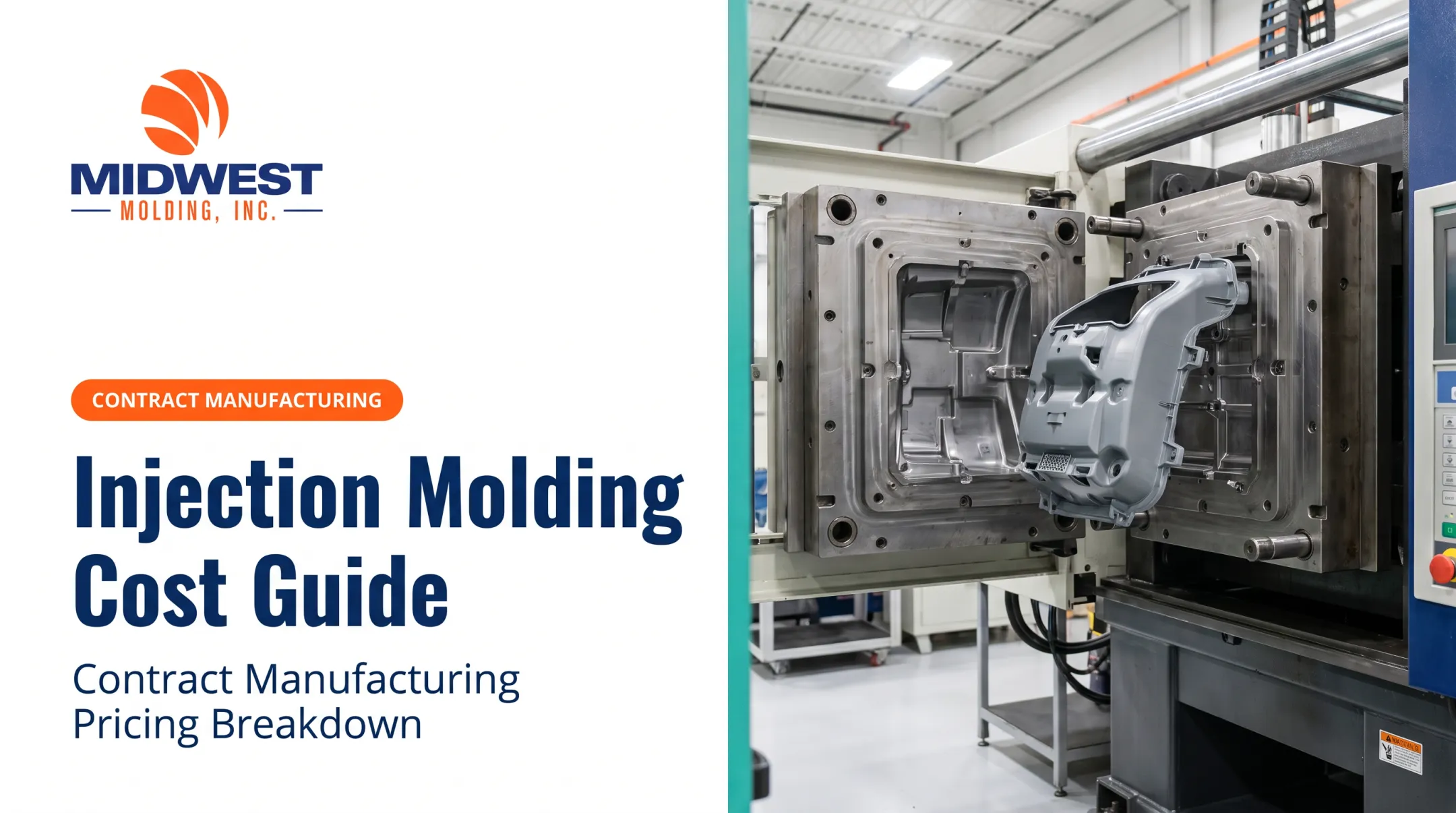
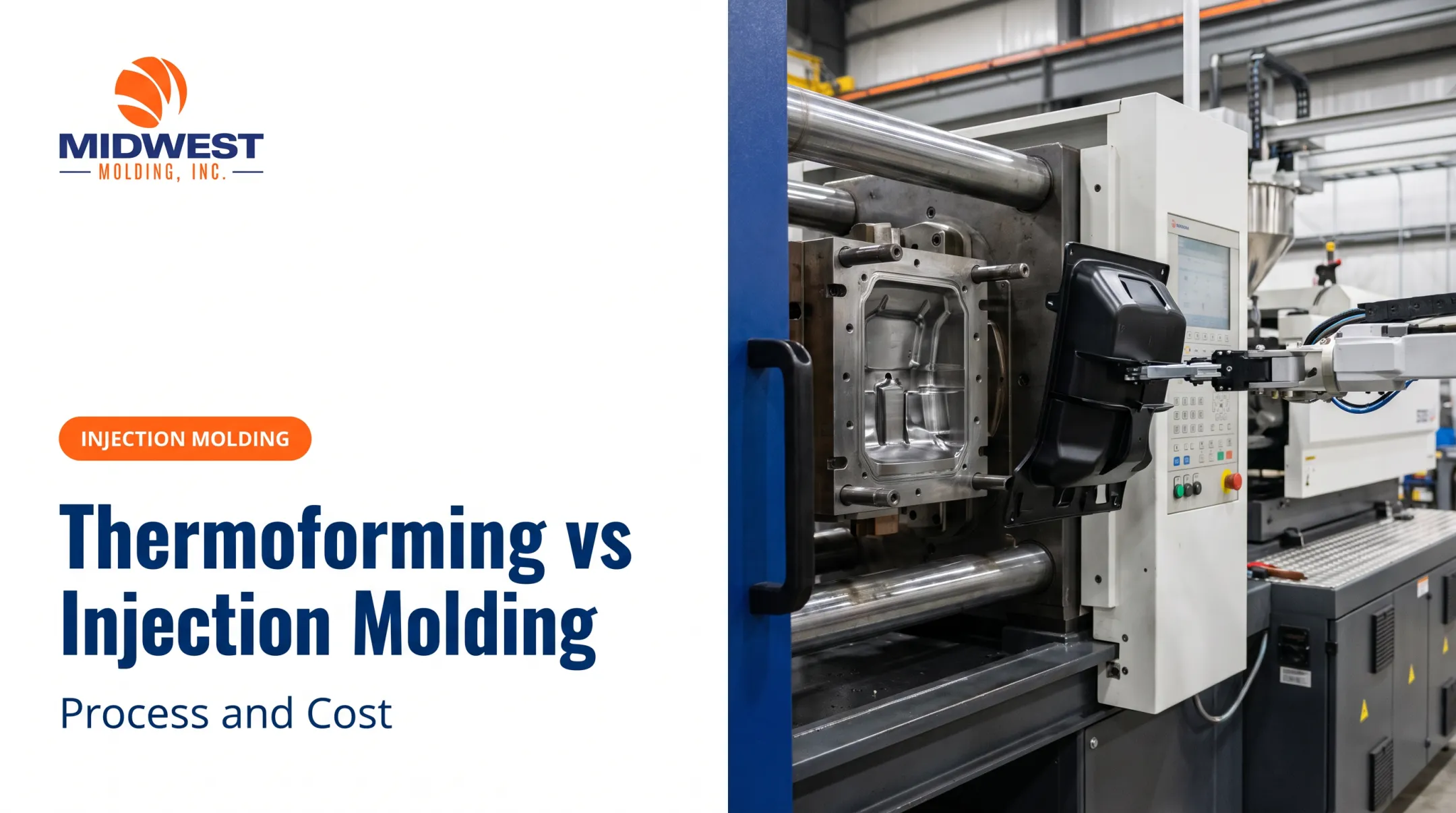
Injection molding melts plastic resin and injects it under pressure into a mold cavity, where it cools and is ejected as a finished part. The production sequence runs: resin preparation, melting, injection, packing, cooling, mold opening, ejection, then any runner or gate trimming.

This process handles complexity that blow molding can't: ribs, bosses, tight dimensional features, textured surfaces, and multiple cavities running at once. Engineered resins and metal or electronic inserts can go straight into the tool.
Main cost drivers:
- Mold complexity, cavity count, slides, and lifters
- Cooling channel design and machine tonnage
- Resin selection and cycle time
- Quality inspection and maintenance requirements
- Production volume (more parts spread tooling cost further)
Several variations consolidate parts or reduce assembly steps:
- Insert molding: plastic molded around a pre-positioned metal or electronic component
- Overmolding: a second resin molded over an existing substrate to combine material properties
- Two-shot molding: sequential resin shots in one mold, eliminating a second press and manual transfer
- Composite molding: combining materials through injection for structural or functional benefits
- Gas-assist molding: nitrogen injected after resin to hollow out thicker sections and save material
Midwest Molding runs these variations across Insert & Composite Molding, Two-Shot, Overmolding & Gas-Assist Molding, and Reel-to-Reel Continuous Strip Molding services. That capability turns a multi-step assembly into a single molded part.
When the tool and process are validated upfront, the payoff is repeatability: fewer manual assembly steps, more predictable cycle times, and lower rework risk downstream.
Use Cases of Injection Molding
Injection molding covers the full product lifecycle, from prototype tooling through high-volume repeat production. Common applications include:
- Automotive housings, connectors, and structural components
- Electrical connectors, terminals, sensors, and switches
- Control modules and HVAC components
- Appliance housings, knobs, and multi-material parts
- Wire-harness assemblies built and overmolded as finished units
Midwest Molding runs 55 all-electric injection molding presses (50 horizontal, 5 vertical) across a broad range of press sizes. That covers everything from straight injection-molded components to multi-component assemblies that combine molding with wire harness assembly and sonic and vibration welding in one supply chain.
Blow Molding vs. Injection Molding: What Is Better?
Neither process is universally better. The first question is whether the part must be hollow or solid. After that, precision, material, volume, tooling budget, and assembly needs decide the winner.
Cost: Upfront vs. Total
Separate the two cost buckets:
- Upfront: Mold design, machine requirements, and tooling build
- Recurring: Resin, cycle time, labor, trimming, scrap, inspection, maintenance, shipping, and downstream assembly
A low mold quote doesn't guarantee a low per-part price. Get project-specific quotes that account for both.
Design and Volume Decision Points
Blow molding suits hollow, lightweight products. Injection molding fits complex, solid, precise, insert-containing, or multi-material parts. Some designs can go either way. A part redesign sometimes makes a second process viable, which is worth exploring before committing to tooling.
Production volume matters just as much as geometry. Tooling amortization and economies of scale shift per-part cost as volume climbs, so a process that looks expensive at low volume can become the cheaper option at scale, and vice versa.

Choosing a Supplier
Evaluate potential partners on:
- Material expertise and design-for-manufacturability support
- Tooling ownership, maintenance, and process validation
- Inspection capability and production capacity
- Lead times and relevant quality certifications
- Ability to support assembly or welding in-house
Midwest Molding holds IATF 16949 certification for automotive quality management and ISO 14001:2015 for environmental management, and guarantees tooling for the life of the program. That track record matters when a part is headed into automotive or electronics production.
Real-World Examples
Blow molding, hollow industrial container: Metro Mold & Design took on a corrosive-fluid container for an electronics OEM that demanded dimensional control across 15 separate features, with some stacked tolerances as tight as 0.010 inch. Rather than assume blow molding couldn't hold that precision, the molder adapted an accumulator-head process and reported no dimensional returns over years of production.
Blow molding's "loose tolerance" reputation has exceptions when mold design and process are dialed in.
Injection molding, integrated automotive component: M.I.H.B. replaced a two-shell, ultrasonic-welded automotive washer nozzle with an integrated multi-shot mold that overmolds the seal in place. The new process runs a 28-second cycle producing eight finished parts, compared to roughly one minute from molding through the previous welding step.

Consolidating the weld into the mold cycle cut both time and handling.
These results aren't directly comparable: one measures container tolerance, the other measures cycle time against a welding process it replaced. Both still show the same principle. The right process, applied to the right part, beats a generic rule of thumb every time.
Companies with complex automotive, electronics, appliance, insert-molded, overmolded, or assembly-ready plastic components can work through these process and production questions with Midwest Molding, Inc., whose capabilities span injection molding, assembly, and welding.
Conclusion
Match the process to the part and the production plan:
- Blow molding for hollow, thin-walled designs where tooling and material economics favor it
- Injection molding for solid structure, complex detail, tighter control, inserts, multiple materials, or integrated features
The best decision compares total lifecycle cost and manufacturing risk, not just the initial mold price. Material use, cycle time, scrap, trimming, and assembly all add up over the life of a production program.
Bring an experienced supplier into the design review early, before tooling, material selection, and production planning are locked in.
Frequently Asked Questions
How much does injection molding cost?
Cost depends on tooling complexity, material, part size, machine requirements, production volume, cycle time, and assembly needs. Get a project-specific quote rather than relying on a general price estimate.
How much does a blow mold cost?
Blow mold cost varies with part size, cavity count, material, neck and handle features, cooling design, automation, and required tolerances. Mold cost is separate from machine time, trimming, validation, and ongoing production costs.
Is blow molding the same as injection molding?
No. Both shape heated plastic inside a mold, but injection molding fills a cavity with molten resin while blow molding expands a parison or preform with air. They typically produce different part geometries.
Which is cheaper, blow molding or injection molding?
Blow molding often has a cost edge for suitable high-volume hollow products. Injection molding can be more economical for complex parts or designs that cut downstream assembly. Volume and total cost determine the real answer.
Which process is better for automotive plastic parts?
Automotive programs use both. Blow molding suits appropriate hollow tanks or ducts; injection molding suits detailed housings, connectors, sensor components, inserts, overmolded parts, and structural components.